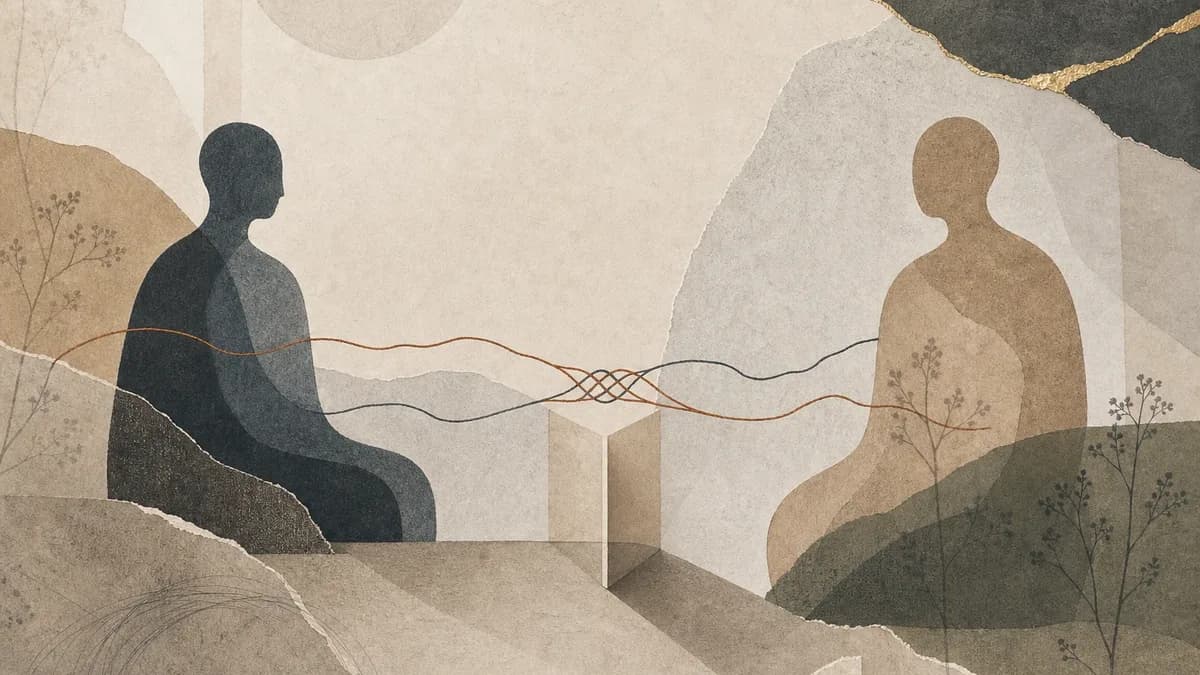
You can go months without stopping to consider where you stand with the people closest to you.
Something has to force the question: a hard conversation, a stretch of distance, a comment that lands badly. The rest of the time these relationships run in the background, changing while you pay attention to everything else.
A relationship check-in journal is a way to look at your relationships with care and curiosity, so you can better understand yourself and the people in your life.
What a relationship check-in journal is
A relationship check-in journal is a recurring reflection on the relationships in your life. Each week you choose one person, a partner or a parent or a close friend or a business partner, and you write about where things stand between you.
The journal can be a private space to gather your thoughts, or a way for both of you to reflect before checking in with each other.
It also gives you a ritual that builds over time. You return to the same questions each week, which lets you compare this week against last week and the month before, and see which direction the relationship has been moving.
The 6 relationship check-in questions
After you choose who you're reflecting on, Rosebud's Relationship Check-in Guided Journal walks you through six questions curated to bring you clarity and insight:
1. Notice what you appreciated this week
Think of something the person did recently that you appreciated, or that made you feel loved. Pick the actual moment rather than a general quality.
Then the follow-up: did you tell them? And if not, how could you?
John Gottman's research on lasting relationships found that stable couples maintain a strong surplus of positive interactions over negative ones, and that this holds during conflict. So the journal asks about appreciation before it asks about anything harder.
2. Reflect on what's going well
Widen the lens from a single moment to the bigger picture. What's working in this relationship right now, and how can you keep nurturing it?
It's easy to focus most of your attention on what's going wrong, which leaves the parts that are working unexamined and then unmaintained. Name them and you'll know what you're protecting.
3. Check your sense of connection
On a scale of 0 to 10, how connected do you feel to this person right now?
Choose the number first, then explore what shaped it, including what you contributed to the emotional climate this week.
The number matters less than the movement between numbers. Solution-focused therapists use scaling questions for that reason: a 6 this week after a 4 last week gives you something to explain.
4. Address what's unspoken
If something has been sitting with you, the journal walks you through it in three parts:
- Feelings: how you feel about it
- Needs: what you need from this person
- Request: one concrete thing you could ask for
This structure comes from Marshall Rosenberg's Nonviolent Communication, and it works because most complaints fuse all three together. "You never help around here" is a feeling, a need, and an accusation at once, and the other person can only defend themselves against it. Pull the three apart and you have something you can say out loud.
You do all of this alone. At the end you have one sentence you could offer to the person.
If nothing is troubling you this week, the journal asks instead about anything you haven't gotten around to saying.
5. Look at the week ahead
What's coming up that touches this relationship? Then two questions:
- What's one thing this person could do to help you feel more supported?
- What's one thing you could do to help them feel more supported?
Ask the first question alone and you end up with a list of ways someone is falling short. Answering both keeps you in the frame too.
6. Close with an affirmation or intention
End with one thing you appreciate or love about this person that you'd like to remind them of this week, and when you'll share it. Or set an intention for the week ahead, along with one specific action that fulfills it.
When you've finished, Rosebud writes you back a short reflection: the themes of your week, some perspective on the dynamic between you, and a single key insight about the relationship to carry forward.
Why a guided journal
You could answer these questions in a notebook or notes app. But a blank page can only hold what you already know to write down.
Rosebud guides you through the reflection one question at a time, responds to what you share, and helps you explore ideas you might otherwise move past. As you return, it can recognize recurring themes and show you how the relationship is changing over time.
Because the Relationship Check-in sits alongside the rest of your journaling, Rosebud can also connect what comes up here with patterns elsewhere in your life, helping you see a thread that a standalone journal entry might miss.
If you'd like more to draw on between check-ins, our 100+ couples journal prompts are organized by the same Gottman categories, and we have a wider set of journaling prompts for relationships. If you're processing the end of a relationship, we also have a guide on journaling through a breakup, backed by research.
Start your first check-in
The Relationship Check-in Guided Journal is free and opens with the only question you need to answer to begin: who would you like to reflect on?
Start an entry in the Relationship Check-in Guided Journal
References
- Gottman, J. M., & Levenson, R. W. (1992). Marital processes predictive of later dissolution: Behavior, physiology, and health. Journal of Personality and Social Psychology, 63(2), 221-233. https://doi.org/10.1037/0022-3514.63.2.221
- De Shazer, S., & Berg, I. K. (1997). 'What works?' Remarks on research aspects of solution-focused brief therapy. Journal of Family Therapy, 19(2), 121-124. https://doi.org/10.1111/1467-6427.00043
- Rosenberg, M. B. (2015). Nonviolent Communication: A Language of Life (3rd ed.). Encinitas, CA: PuddleDancer Press.